Graduation Planning 101
How to Craft an Official Graduation Program
Your graduation program is a complete outline of your commencement ceremony. Your graduation program will list what will happen and in what order. It also lists all of the students who will be walking, noting all awards and achievements. It's up to the event coordinator and their graduation committee to make sure the programs get designed, approved, printed, and distributed.
If you are the graduation coordinator, you have probably started thinking about your program already. Let's dive into its separate components, shall we?
This article is an excerpt from "The Graduation Planning Handbook" by GraduationSource.
Master Program vs. the Public Program
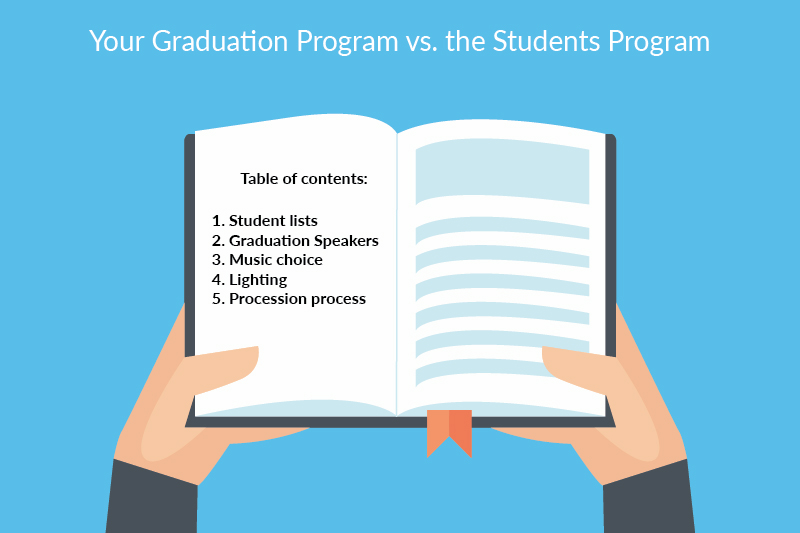
We highly recommend that you have two versions of your program. One that will be passed out to students and guests as a keepsake and another that serves as a master planning document. You will use your master graduation program ‘behind the scenes” to ensure your event runs as smooth as silk.
Master Program
In the master graduation program, you will have every ceremony detail – from soup to nuts. Your program will be quite long, including timing cues, stage directions, and other mission critical items. It should also include information such as lighting and music cues. You will want to distribute copies of the master to everyone on the planning committee and those who will be on stage. You may even give copies to some of your vendors, the DJ/sound people in particular.
Public Program
The public graduation program for students and parents will contain the names of all of the graduates and administrators. It will also include the names of everyone speaking and order of events. Essentially, it's a guide for how the event will unfold for those attending it.
Advertising Opportunities
Some schools choose to sell advertising space to parents, students, and extended family. While this is harder to coordinate, it's an excellent fundraising opportunity for your school. You can sell anywhere from a 1/2 page to a 1/16 page where loved ones can insert encouraging words or baby photographs. Some schools reach out to local businesses offering them ad space, slightly tacky, but when your school needs money, it needs money.
Our Best Tips:
As you can see, there are some differences between the two different programs. But there are also some similarities. Here are details and factors you will want to keep in mind when planning both programs.
Plan the Handing Out of Diplomas
Most likely, the biggest highlight of graduation for students and all in attendance is the diploma walk. Everyone remembers the moment they or a loved one walk across the stage, diploma in hand. The graduation coordinator has to plan the best way to hand them all out.
The key to success is seating. Arrange your students alphabetically outside of the seating area. Then have them file in, sit down, and later get up, and sit down again, all in that same order.
Typically you'll want to hold a trial run to see how long it takes a row of people to file in, line up, and walk across the stage with appropriate pauses in between the announcement of each student's name.
When the student reaches you, you shake their hand, move their tassel from right to left, hand them their diploma, then they file off the other side of the stage. Repeat until all students have walked! Simple, in theory anyway.
Our best tips:
Grab a timer and figure out how long it will take per student, multiply that by the number of students, and now you have the total time it will take to award each student with a diploma. Jot that down on you master program!
Plan the Allotted Time for the Speakers
You may not yet know who will be speaking, but you should be aware how many people you want to deliver speeches. If you're like most schools, you will max out at five people. Typically, the superintendent, the principal, a keynote (to be determined), the valedictorian, and the salutatorian.
It is critical that the graduation coordinator set time certain time frames for each person delivering a speech. That way so they can practice their speeches for timing as well as quality. We advise you tell all speakers that seven minutes is the limit. The best talks leave people wanting more, not falling asleep in their chairs.
If anyone should speak for a longer duration, it should be the Keynote. The keynote should be a local or national celebrity, hero, or someone who has an inspiring story to tell. Manage the time carefully so that the entire graduation ceremony program can fit into the given schedule.
Our best tips:
Confirm the proper spelling, title, and pronunciation of each of your speaker's names before adding them to the program or having the Emcee announce them. Consider including 3-5 sentences bios of each speaker in the program.
Plan the Musical Numbers
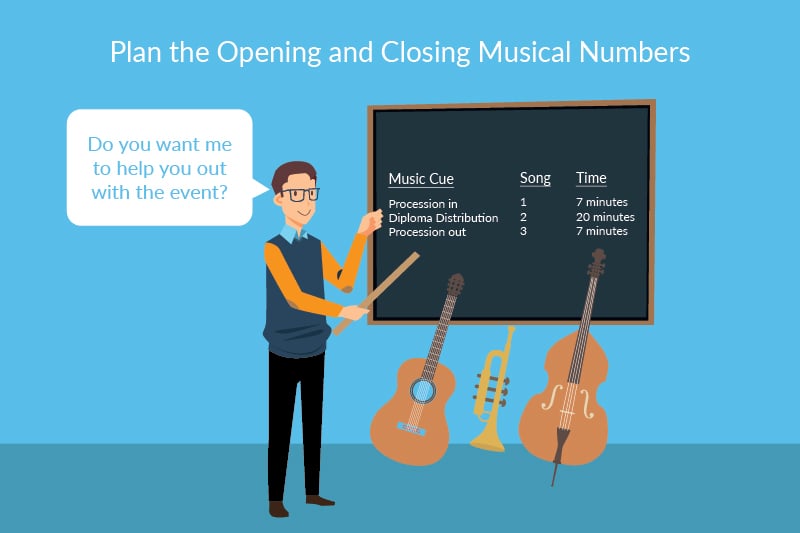
Every eye will be on the graduates as they make the processional walk to their seats. Chose a lively song for this exciting moment, and play it loud. You'll need another song for when they are walking across the stage and a final one for when they all walk out.
While there are traditional songs associated with graduation, ones used for generations, you may want to consider modernizing. At the movies, a good soundtrack can keep patrons in their seats even when the movie itself is less than great. Same goes for graduation ceremonies.
For music ideas, check out our other graduation planning articles on that subject.
Our best tips:
Coordinate with the band director or DJ to keep the music playing while event guests start to get seated. It will help keep everyone occupied while they wait for the ceremony to start.
Finalize the Graduation Programs
Assuming you're not waiting on confirmations from speakers or ads from parents and local businesses, you should be able to complete both programs. Even if you are waiting for those things, you should still be able to hammer out solid draft versions.
Design and Layout
Many are tempted to keep their programs somewhat bland. You can, of course, do so, but we don't advise it. Add a bit of color, add a bit of design, and make them unique. The master program can and should be simple, as it's not a keepsake. The program a parent receives can live on for decades in a memory box or a
mounted frame. Make them keepsake worthy! Enlist the help of your school's marketing or art clubs if you're not the creative type.
Printing
Once the final public program design is approved, it's time to contact a print shop. We recommend you order at least four times as many programs as you have students graduating. Keep in mind, every student will want a copy and so will their parents. You can obtain competitive quotes from places like NextDayFlyers, or just order locally to keep the money in the community. When it comes to the master program copies, you can just print those at the school on plain paper.
Our best tips:
Print extras of both programs, just in case. Try to order the printing close to graduation in case anything changes with the graduation lineup.
Distribute the Graduation Program
Circulate the master program around the graduation committee as soon as possible. They need to be on top of all the moving parts.
The public program for the students and parents can be mailed out, but we don't advise it. The easiest options are to either have your ushers leave a copy on every seat, or to organize them at the entrance with a sign informing guests to take one.
Our best tips:
Ask your committee to double check both programs before printing and distribution. It's better to find a mistake early in the printing process.
Practice Makes Perfect
What’s that old saying? “Practice makes perfect, ” and yes it does! Your event committee needs to prepare for graduation day. The master program is one of the helpful ways everyone will be ready. Once everyone has a copy of the master program, schedule a meeting to review the order of the events. Your master program should have notations citing who needs to be where and when. Make sure team members know what you expect of them!
During graduation rehearsals, you may even consider informing students about the details of the master program. It is the job of the coordinator to make sure that everyone has an idea about the particulars of the graduation ceremony and what role they will play.
Our best tips:
Plan your event committee meeting and rehearsal as soon as you’ve got your programs!
Download and Subscribe
Keep a look out for additional articles if you want to learn more! There will be many
articles about graduation planning on our blog in the weeks to come.
If you'd like to be in the loop about graduation, student, faculty, and other education topics,
subscribe to our blog.
To get a free copy of
“The Graduation Planning Handbook” download it here.
If you'd all our guides, a newsletter subscription, and free product samples all at the same time
request